

Why Colleges Must Move from One-Time Training to Long-Term Industry-Mentoring Partnerships
Campus-to-Corporate Is Not a Workshop. It Is a Journey.
For decades, the traditional college employability model has followed a familiar pattern:
Academic curriculum → Final-year training → Placement preparation → Campus recruitment
That model is increasingly inadequate.
The workplace students are entering in 2026 is changing faster than most academic calendars can respond. Artificial intelligence is changing job roles, digital tools are changing productivity, employers are becoming more skills-focused, and professionals are expected to continuously reinvent themselves.
The question for colleges is therefore no longer simply:
“How do we prepare students for campus placements?”
It is becoming:
“How do we prepare students to remain relevant, employable and capable of leadership throughout a 30–40-year career?”
That is why colleges need to rethink the role of corporate training and business consulting firms—from occasional training vendors to long-term industry-learning and mentoring partners.
- The Employability Challenge Begins Before the Final Year
India’s graduate employability numbers show both progress and a continuing challenge.
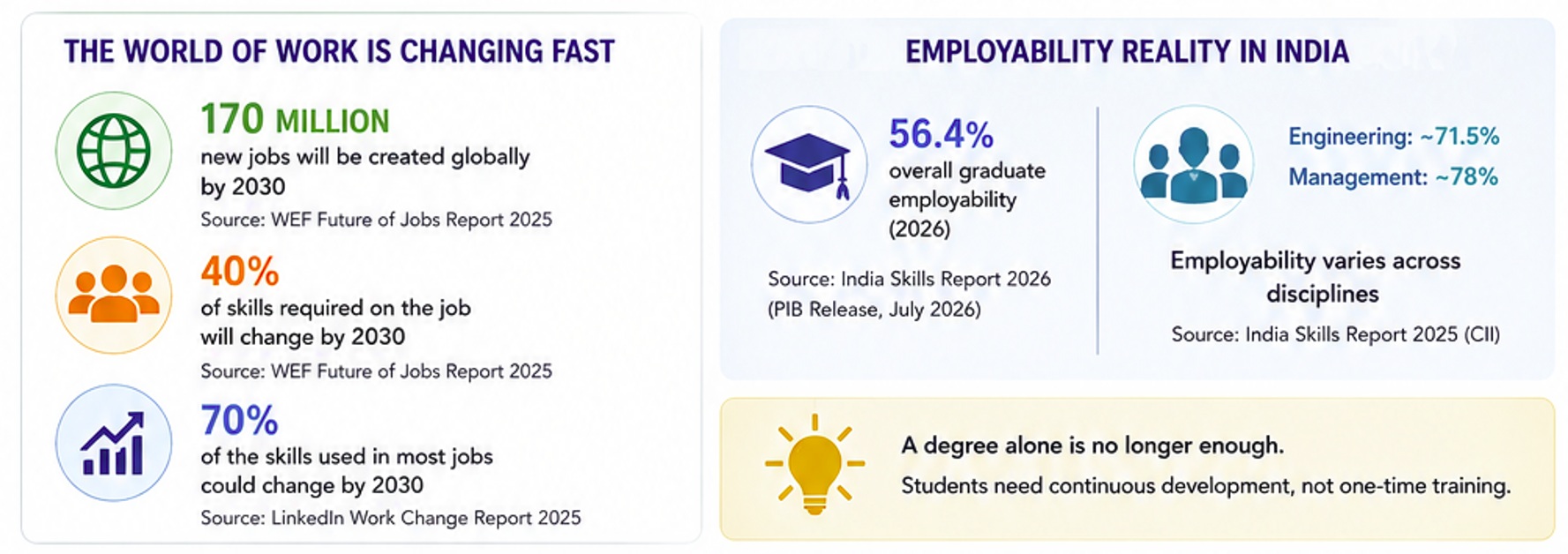
The India Skills Report 2025, based on assessments involving more than 6.5 lakh candidates and insights from 1,000+ corporations, reported graduate employability at 54.81%. It reported employability of approximately 71.5% for engineering graduates and 78% for management graduates. (CII)
The latest India Skills Report 2026 indicates further improvement, with overall employability reaching 56.4% according to a July 2026 Government of India/PIB release. (Press Information Bureau)
These numbers are encouraging—but they also reveal something important:
A degree does not automatically equal workplace readiness.
A student may understand algorithms, finance, marketing, engineering principles or business theory and still struggle with:
- Communicating an idea clearly
- Working with a diverse team
- Handling disagreement
- Presenting to senior people
- Thinking critically under pressure
- Solving ambiguous problems
- Using AI responsibly
- Demonstrating leadership
- Adapting when the original career plan changes
This is precisely where a continuous industry-mentoring ecosystem can make a difference.
- The Future of Jobs Is Not a Distant Future
The World Economic Forum’s Future of Jobs Report 2025 projects that structural labour-market transformation could create 170 million jobs globally by 2030 while displacing 92 million, producing a net gain of 78 million jobs. That represents significant churn—not simply job creation or job destruction. (World Economic Forum)
Even more significant for education leaders is the skills dimension.
The WEF estimates that nearly 40% of the skills required on the job are expected to change by 2030. Employers identify skills gaps as one of their major barriers to transformation. Alongside AI, big data and cybersecurity, employers continue to emphasize human capabilities such as creative thinking, resilience, flexibility, agility, leadership and social influence. (World Economic Forum)
LinkedIn’s 2025 Work Change Report similarly estimates that 70% of the skills used in most jobs could change by 2030. (LinkedIn Pressroom)
For a college, this has a profound implication:
The skills students need in Year 1 may not be exactly the skills they need in Year 4.
And the skills they need in their first job may not be the skills required to become a manager five years later.
Therefore, employability development must become continuous.
- AI Has Changed the Meaning of “Career Readiness”
AI is not merely another software tool that students can learn in a workshop.
It is changing how work itself is performed.
Microsoft’s 2025 Work Trend Index found that 82% of leaders globally viewed 2025 as a pivotal year to rethink strategy and operations, while leaders anticipated employees increasingly working with AI agents. Microsoft also reported that 83% of leaders surveyed believed AI would enable employees to take on more complex and strategic work earlier in their careers. (The Official Microsoft Blog)
Its India findings were even more striking: 93% of Indian business leaders surveyed said they intended to use AI agents to extend workforce capabilities within 12–18 months, while 51% cited upskilling as a top priority. (Source)
And Microsoft’s 2026 Work Trend Index shows the transition continuing: analysis of more than 100,000 Copilot conversations found that 49% of the conversations supported cognitive work such as analysing information, solving problems, evaluating and thinking creatively. (Microsoft)
So colleges should not ask only:
“Can our students use AI?”
They should ask:
“Can our students think, communicate, judge, collaborate and lead effectively while using AI?”
That is a much bigger challenge.
- Why One-Day Campus-to-Corporate Training Is Not Enough
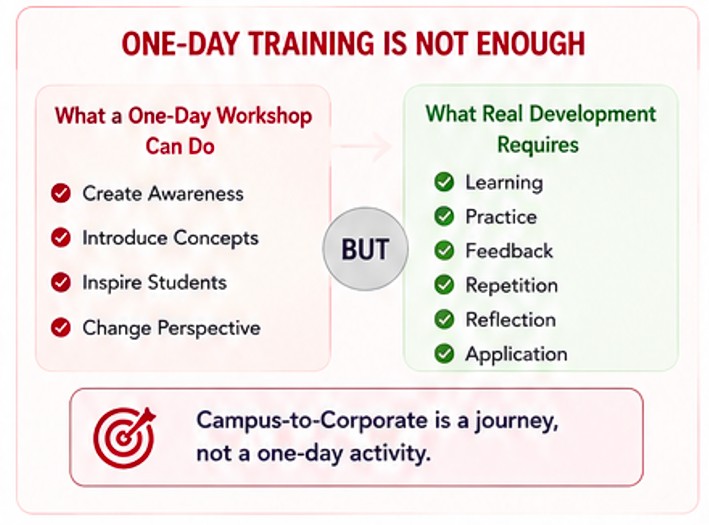
A one-day workshop can be powerful.
It can inspire students.
It can introduce concepts.
It can create awareness.
It can even change someone’s perspective.
But one day cannot create a professional identity.
Consider communication.
A student may attend an eight-hour communication workshop and learn:
- How to introduce themselves
- How to present
- How to participate in a GD
- How to answer interview questions
But communication competence develops through:
Learning → Practice → Feedback → Repetition → Reflection → Application
The same applies to:
- Leadership
- Emotional intelligence
- Critical thinking
- Negotiation
- AI adaptation
- Executive presence
- Problem solving
- Career planning
These are behavioural capabilities, not chapters in a textbook.
Therefore:
A workshop should be treated as an intervention—not the entire development journey.
- The New Model: Campus → Corporate → Career → Leadership
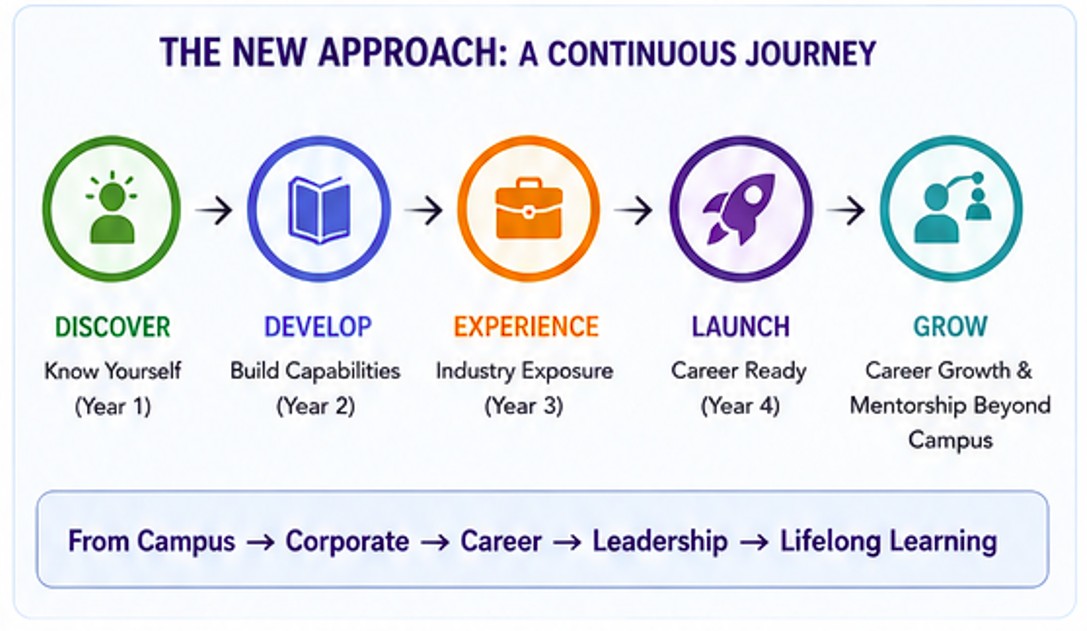
The college of the future should think in terms of a development continuum.
YEAR 1
Discover Yourself
Students develop:
- Self-awareness
- Growth mindset
- Communication
- Confidence
- Teamwork
- Career awareness
YEAR 2
Build Capability
Students develop:
- Critical thinking
- Leadership
- Problem solving
- AI literacy
- Professional communication
- Collaboration
YEAR 3
Experience the Corporate World
Students develop:
- Business thinking
- Industry exposure
- Projects
- Presentations
- Personal branding
- Professional networking
YEAR 4
Become Placement & Career Ready
Students develop:
- Resume
- GD
- Interviews
- Assessment-centre skills
- Corporate etiquette
- AI-enabled job search
- Career strategy
Then the journey continues:
First Job → Performance → Career Growth → Management → Leadership → Entrepreneurship
That is the real meaning of Campus to Corporate and Beyond.
- Why Long-Term Industry Mentoring Matters
A trainer generally asks:
“What should I teach today?”
An industry mentor asks:
“What will this student need to succeed five years from now?”
That distinction is enormous.
A mentor can tell students:
- What recruiters actually look for
- Why technically strong candidates sometimes fail interviews
- How managers evaluate employees
- What makes someone promotable
- How workplace politics actually works
- How to communicate with senior stakeholders
- How to handle failure
- How to make career transitions
- How AI may change their role
- How to build professional credibility
Students receive something that textbooks cannot easily provide:
Context.
And context is becoming increasingly important in an AI-driven workplace.
Recent industry-academia collaborations in India are already moving in this direction. For example, a recent UPES-Salesforce initiative emphasized that the AI talent gap is increasingly about applying knowledge in enterprise context, not merely knowing AI concepts. (Express Computer)
That is exactly why academia and industry need to move closer.
- Career Counselling Can No Longer Be a Final-Year Activity
Traditional career counselling often happens when students are already approaching graduation.
But today’s career landscape is too fluid for that model.
A student entering a B.Tech programme may eventually become:
Software Engineer → Product Specialist → Product Manager → Technology Leader
Or:
Developer → AI Specialist → Consultant → Entrepreneur
Or:
Engineer → MBA → Consultant → Business Leader
Similarly, an MBA graduate may move from:
Management Trainee → Manager → Senior Manager → Business Head → Entrepreneur
The initial degree is only the starting point.
Students therefore need opportunities to revisit:
- Career goals
- Skill gaps
- Industry trends
- Professional identity
- Personal strengths
- Learning priorities
- AI disruption
- Entrepreneurship opportunities
at different stages.
Career counselling should evolve from:
“Which job should I take?”
to:
“How should I continuously design my career?”
- Lifelong Career Mentoring Is Becoming More Relevant
The Government of India itself is increasingly framing skill development as a whole-of-life journey, integrating education, skilling, employment and entrepreneurship.
A July 2026 PIB release explicitly highlighted the need for continuous upskilling as automation, AI and digitalisation reshape labour markets, and described partnerships between academia and industry as important to building an industry-responsive talent ecosystem. (Press Information Bureau)
This is a significant shift.
The college of the future should not think:
“Our responsibility ends when the student receives a degree.”
Instead:
“Our relationship with the learner can evolve as the learner progresses through life.”
That opens the door to structured alumni mentoring, career counselling, industry interaction, entrepreneurship support and continuous professional development.
- What Does a True Industry-Academia Partnership Look Like?
A meaningful partnership should go beyond:
Guest Lecture → Certificate → Photograph → Social Media Post
That model has value, but it is insufficient.
A stronger model is:
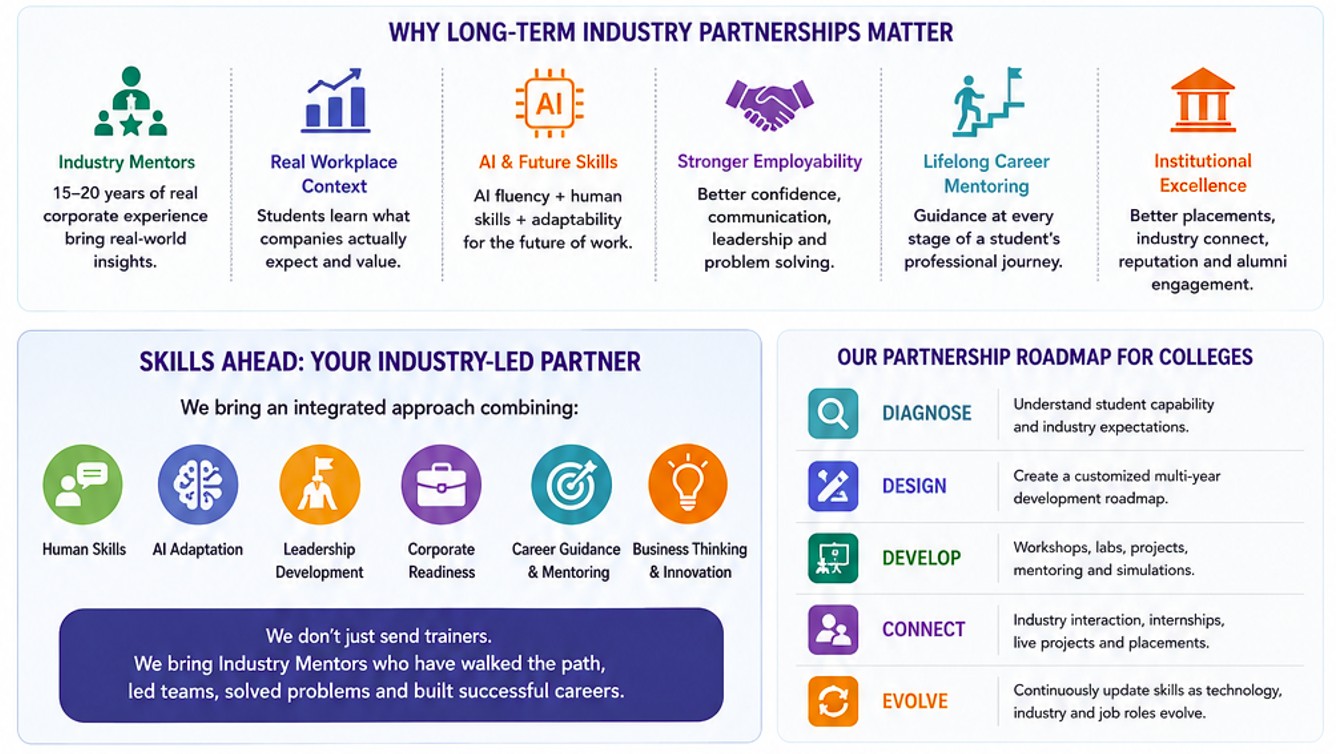
DIAGNOSE
Understand student capability and industry expectations.
↓
DESIGN
Create a structured development roadmap.
↓
DEVELOP
Conduct workshops, labs, simulations and mentoring.
↓
EXPOSE
Bring industry professionals into the learning environment.
↓
APPLY
Projects, cases, challenges and workplace simulations.
↓
ASSESS
Measure development and identify gaps.
↓
MENTOR
Provide continuing guidance.
↓
CONNECT
Link students with industry, internships and career opportunities.
↓
EVOLVE
Continuously update the programme as technology and jobs change.
This is not a training calendar.
It is a talent-development ecosystem.
- Where Corporate Training & Business Consulting Firms Fit In
The role of an external corporate learning partner should not be to replace the college.
It should be to extend the college’s capabilities.
A good partner can bring:
Industry Experience
Professionals who have actually worked inside organizations.
Current Workplace Context
What companies are using and expecting today.
Emerging Technology
AI tools, digital workflows and new ways of working.
Leadership Experience
Real examples of managing teams and businesses.
Business Cases
Problems students don’t encounter in textbooks.
Corporate Behaviour
How professionals communicate, collaborate and make decisions.
Career Intelligence
Understanding how career paths evolve after graduation.
This creates a powerful combination:
Academic Foundation + Industry Context + Experiential Learning + Continuous Mentorship
- The Skills Ahead Approach
This is where Skills Ahead Consultancy Services Pvt. Ltd. can play a differentiated role.
Skills Ahead is positioned not merely as a training vendor but as an industry-led learning, leadership and career-development partner.
Its distinctive proposition is:
“We Don’t Just Send Trainers. We Bring Industry Mentors.”
The mentors associated with Skills Ahead bring 15–20 years of corporate/MNC experience, including experience in leadership, management, HR, technology, business and consulting.
This allows students to learn from professionals who have:
Walked the path → Experienced the challenges → Made decisions → Led people → Built careers
The model combines:
HUMAN SKILLS
Communication • Emotional Intelligence • Critical Thinking • Leadership
AI ADAPTATION
AI Tools • AI Productivity • Digital Fluency • AI-enabled Workflows
CORPORATE READINESS
Interviews • GD • Presentation • Professional Behaviour • Workplace Skills
CAREER DEVELOPMENT
Career Planning • Personal Branding • Mentoring • Professional Growth
LEADERSHIP
Decision Making • Influence • Team Leadership • Strategic Thinking
BUSINESS THINKING
Problem Solving • Design Thinking • Innovation • Business Consulting
- A Long-Term Success Roadmap for Colleges
Skills Ahead’s partnership model can be structured around a simple principle:
One Institution. One Development Philosophy. Multiple Career Stages.
B.TECH — 4-YEAR JOURNEY
Year 1: Human & Career Foundations
Year 2: Skills & Leadership Development
Year 3: Industry & Business Readiness
Year 4: Placement & Career Launch
MBA — 2-YEAR JOURNEY
Year 1: Management Foundations & Professional Identity
Year 2: Corporate Leadership & Career Excellence
MCA
Technology → AI → Human Skills → Business Context → Corporate Readiness
And across all programmes:
Industry Mentors + AI Adaptation + Human Skills + Career Guidance
- The Business Case for Colleges
For college leadership, this is not simply a student-training decision.
It is an institutional positioning decision.
A college that invests in continuous employability development can strengthen:
- Student satisfaction
- Parent confidence
- Industry relationships
- Placement preparedness
- Corporate engagement
- Alumni relationships
- Institutional differentiation
- Admissions positioning
- Academic-industry collaboration
The competitive question is changing.
Earlier:
“Which college has the better curriculum?”
Increasingly:
“Which college prepares me better for the world after graduation?”
And tomorrow:
“Which college continues to support my professional growth after graduation?”
That is where a long-term industry partnership can become strategically valuable.
- The College of the Future
The college of the future will not be defined only by classrooms, laboratories and infrastructure.
It will be defined by the quality of the ecosystem surrounding the learner.
Imagine a student entering college at 18.
At 18:
Discover
At 19:
Develop
At 20:
Experience
At 21:
Launch
At 23:
Grow
At 27:
Lead
At 30:
Build
The institution may not control every stage.
But it can create an ecosystem that gives the learner access to knowledge, industry, mentors, technology, networks and guidance at every important transition.
- The Winning Formula for the New Age
The old formula was:
Degree + Placement Training = Job
The emerging formula is:
Degree
Human Skills
AI Fluency
Industry Exposure
Leadership
Continuous Mentoring
Career Adaptability
=
Future-Ready Professional
The World Economic Forum’s projections make the urgency clear: the labour market is undergoing significant structural change, while LinkedIn’s data suggests the skills used in most jobs could change dramatically by 2030. (World Economic Forum)
The response cannot be another isolated workshop.
It has to be continuous capability development.
The Opportunity for Colleges
The most progressive institutions will increasingly move from:
Training Vendors
to
Strategic Learning Partners
From:
One-Day Workshops
to
Multi-Year Development Roadmaps
From:
Placement Preparation
to
Career Readiness
From:
Career Counselling
to
Career Mentorship
From:
Technical Education
to
Technical + Human + AI + Leadership Development
And from:
Campus to Corporate
to:
Campus → Corporate → Career → Leadership → Lifelong Learning
Skills Ahead: A Partnership for the Journey
Skills Ahead Consultancy Services can support colleges in making this transition through an industry-mentor-led Future-Ready Professional Development Partnership.
The objective is not to add another programme to an already crowded academic calendar.
The objective is to create a structured development layer around the existing academic ecosystem.
Students continue to receive their academic education from the institution.
Skills Ahead brings:
Industry Context + Human Skills + AI Adaptation + Leadership + Experiential Learning + Career Mentoring
Together, the institution and industry partner can create something considerably more valuable than a training programme:
A Future-Ready Talent Ecosystem.
Because the real measure of a college is not simply how many students graduate.
It is:
How many students leave prepared to learn, adapt, contribute, lead and continue growing in a world that will keep changing.
And that is why Campus-to-Corporate should no longer be viewed as a one-day activity.
It should be treated as a long-term investment in human potential.
Are you looking for a long-term strategic growth partner committed to developing your students beyond academics?
Then Skills Ahead Consultancy Services Pvt. Ltd. can be your first-choice industry-led learning and development partner.
We don’t believe in one-day training alone. We build continuous Campus-to-Corporate development journeys integrating Human Skills, AI Adaptation, Leadership, Employability, Industry Exposure and Career Mentoring.
Why Skills Ahead?
- 15–20 years of corporate/MNC experience — our mentors bring real industry experience, not just training theory.
- Student development beyond placement — from first year foundation to corporate readiness and leadership.
- AI + Human Skills + Leadership — preparing students for the rapidly changing world of work.
- Long-term structured roadmaps — designed around the development needs of B.Tech, MBA, MCA and other degree students.
- Industry-led mentoring & career guidance — helping students prepare not only for their first job, but for the career journey beyond.
Let’s build a future-ready institution together.
Skills Ahead Consultancy Services Pvt. Ltd.
🌐 www.skillsahead.net
📞 +91 9990741930
📧 info@skillsahead.net
PAN India Online | Delhi/NCR Offline
Developing Human Skills. Building Future Leaders.