
the College of the Future
Beyond Degrees: How Forward-Thinking Colleges Are Building Future Leaders Through Human Skills, AI Readiness and Lifetime Career Development
The Best Colleges Don’t Just Award Degrees. They Build Lives.
A university education was once considered the final preparation for a successful career. Today, however, the world has changed dramatically.
Artificial Intelligence is transforming industries. Job roles are evolving faster than university curricula. Technical skills have shorter shelf lives, and employers increasingly seek graduates who can think critically, communicate effectively, lead teams, solve complex problems, and adapt continuously.
The question facing every educational institution is no longer:
“How many students graduated?”
It is:
“How many graduates are truly prepared to thrive for the next 30 years?”
The answer lies beyond classrooms, textbooks, and examinations.
It lies in developing human potential.
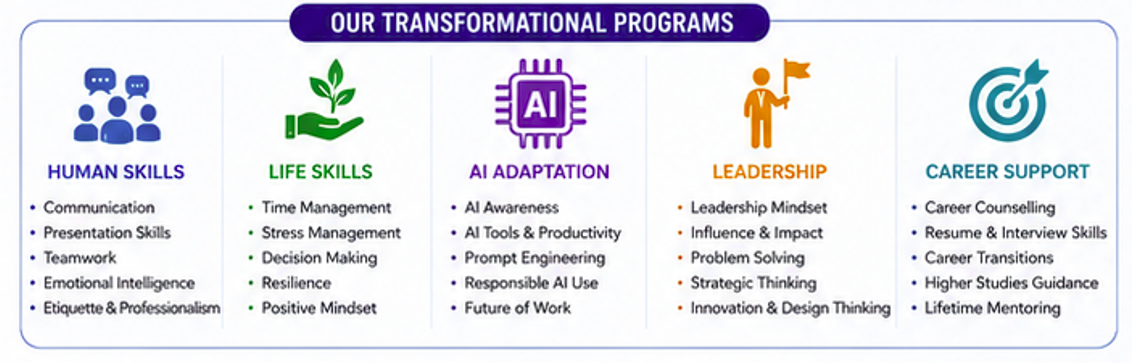
This is precisely where progressive institutions are partnering with Skills Ahead Consultancy Services Pvt. Ltd. to redefine student development through Human Skills, Leadership Development, AI Adaptation, Career Counselling, and lifelong mentoring.
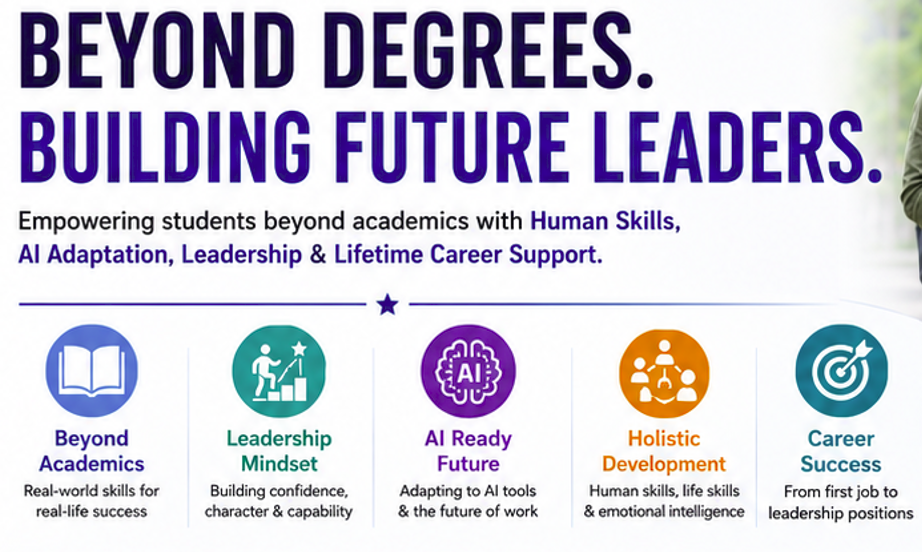
Education Is Shifting from Knowledge Transfer to Human Transformation
Leading institutions across India are recognizing an important reality.
Students no longer need only information.
Information is available everywhere.
What they truly need is:
- Direction
- Confidence
- Emotional Intelligence
- Leadership
- Professional Identity
- Decision-making ability
- Learning Agility
- Career Strategy
- Mental Resilience
- AI Readiness
These competencies are difficult to develop through traditional academic curricula alone.
They require experiential learning, coaching, mentoring, reflection, and practical application.
Why Human Skills Have Become the New Competitive Advantage
Technical knowledge may help students qualify for interviews.
Human Skills determine whether they become future leaders.
Research from employers consistently shows demand for capabilities such as:
- Communication
- Critical Thinking
- Leadership
- Emotional Intelligence
- Creativity
- Collaboration
- Problem Solving
- Adaptability
- Learning Agility
- Professional Ethics
These are often referred to as durable skills because they remain valuable even as technology changes.
Artificial Intelligence can generate reports.
It cannot replace:
- Trust
- Empathy
- Influence
- Purpose
- Vision
- Character
- Ethical judgment
- Inspirational leadership
The future belongs to professionals who combine AI capability with exceptional human capability.
Student Development Is No Longer Limited to Campus
One of the biggest challenges graduates face is that life continues long after placement.
Students encounter new questions every few years.
Examples include:
“How do I succeed in my first corporate job?”
“How do I become a team leader?”
“How do I communicate with senior management?”
“Should I switch jobs?”
“Should I pursue higher studies?”
“Should I start my own business?”
“How do I manage stress?”
“How do I rebuild confidence after failure?”
“How do I maintain work-life balance?”
Traditional education rarely prepares students for these transitions.
This is where continuous mentoring becomes valuable.
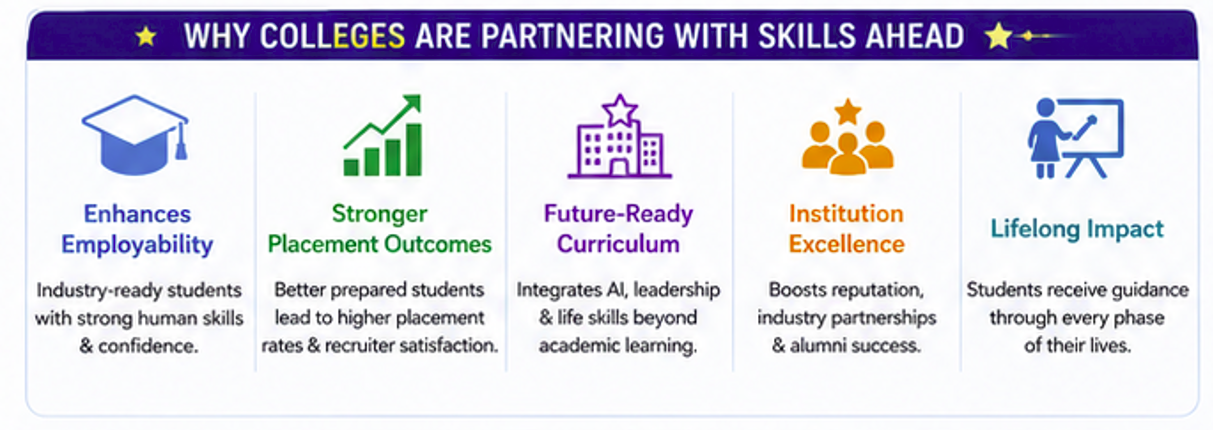
Skills Ahead: From Training Provider to Lifetime Growth Partner
Skills Ahead Consultancy Services has designed its programs around a broader philosophy:
Student development should continue throughout an individual’s professional journey.
Rather than viewing employability as a single placement event, Skills Ahead emphasizes continuous growth across career stages through practical learning, mentoring, and coaching.
Its programs are designed to support learners in areas such as:
- Human Skills Development
- Leadership Development
- AI Adaptation
- Employability Skills
- Career Planning
- Executive Communication
- Business Growth Mindset
- Professional Decision-Making
- Continuous Learning
The aim is to help individuals build capabilities that remain relevant across changing industries and technologies.
Developing a Leadership Mindset from College Itself
Leadership is not merely about managing people.
Leadership begins with:
Self-awareness.
Self-discipline.
Purpose.
Responsibility.
Decision-making.
Integrity.
Influence.
Resilience.
The most successful professionals begin developing these qualities long before receiving their first promotion.
Skills Ahead’s learning philosophy encourages students to think beyond securing a job and instead focus on becoming professionals who create value, lead teams, and contribute meaningfully to organizations and society.
Leadership development activities may include:
- Business simulations
- Team challenges
- Public speaking
- Presentation mastery
- Design Thinking
- Negotiation exercises
- Emotional Intelligence workshops
- AI-enabled productivity
- Strategic thinking
- Goal-setting frameworks
These experiences help students develop confidence alongside competence.
AI Readiness: Preparing Students for Tomorrow’s Workplace
Today’s employers increasingly expect graduates to understand how AI fits into everyday work.
Rather than replacing foundational learning, AI literacy can enhance students’ productivity and problem-solving.
Training may include:
- Understanding Generative AI
- Responsible AI use
- AI productivity tools
- Prompt design fundamentals
- AI-assisted research
- Workplace automation concepts
- Ethical AI practices
Students also learn an important principle:
AI should amplify human capability—not replace critical thinking or professional responsibility.
Supporting Students Through Career Transitions
Career development rarely follows a straight line.
Graduates may move through multiple transitions:
- Campus to first job
- Individual contributor to team lead
- Specialist to manager
- Employee to entrepreneur
- Career change
- Return after a career break
Structured mentoring during these phases can help individuals make informed decisions, strengthen professional confidence, and navigate uncertainty more effectively.
Skills Ahead’s broader approach emphasizes continuous guidance alongside skill development rather than limiting support to interview preparation alone.
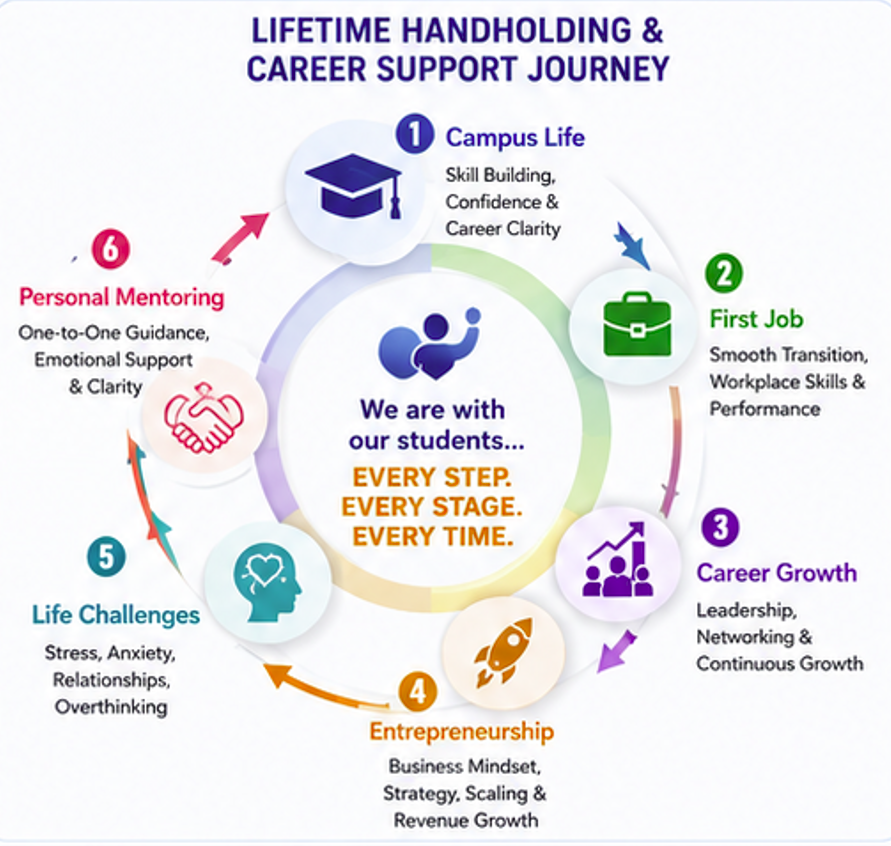
Emotional Well-being and Professional Success
Career success is closely connected with psychological well-being.
Professionals may experience periods of:
- Performance pressure
- Decision fatigue
- Self-doubt
- Burnout
- Workplace stress
- Imposter syndrome
- Career uncertainty
- Overthinking
- Emotional exhaustion
Many also face personal challenges involving relationships, family responsibilities, or major life transitions.
These experiences are common, but they vary widely from person to person.
While training programs can build resilience, self-awareness, communication skills, and stress-management strategies, it is important to recognize that mental health concerns such as significant anxiety, depression, or trauma may require support from qualified mental health professionals.
Organizations and educational institutions increasingly acknowledge that career success depends not only on technical ability but also on emotional well-being and access to appropriate support when needed.
Creating a Growth Mindset Instead of a Placement Mindset
One of the most powerful psychological concepts in education is the Growth Mindset, introduced by psychologist Carol Dweck.
Students with a growth mindset believe:
“I may not know it today, but I can learn.”
Instead of fearing failure, they treat setbacks as learning opportunities.
Skills Ahead encourages this orientation by helping students:
- Build confidence through practice
- Reflect on feedback
- Strengthen adaptability
- Set meaningful career goals
- Develop lifelong learning habits
These habits are increasingly valuable in an AI-driven economy where continuous reskilling is essential.
Learning Beyond the Classroom
Future-ready institutions increasingly complement academic teaching with practical development experiences such as:
- Leadership workshops
- AI readiness sessions
- Career planning
- Communication labs
- Industry interactions
- Mock interviews
- Business simulations
- Innovation challenges
- Mentoring conversations
These initiatives help students connect academic knowledge with workplace expectations.
Learning from Leading Institutions
Many leading universities and institutes, including institutions such as IIT Guwahati, regularly host leadership talks, industry interactions, entrepreneurship initiatives, innovation programs, and professional development activities to broaden students’ exposure beyond classroom learning.
Such examples demonstrate the value of integrating academic excellence with industry engagement and holistic student development.
Each institution’s programs, objectives, and outcomes are unique, and specific benefits should be attributed only where independently documented.
The College of the Future
Tomorrow’s most respected institutions will likely be recognized not only for academic rankings but also for producing graduates who are:
- Confident communicators
- Ethical professionals
- Adaptable learners
- Emotionally intelligent collaborators
- AI-ready contributors
- Innovative thinkers
- Responsible leaders
Parents increasingly seek institutions that prepare students for life—not only for examinations.
Employers seek graduates who can contribute from day one.
Students seek guidance that continues beyond graduation.
Conclusion: Building Careers, Developing People
The future of higher education extends beyond delivering knowledge.
It is about developing people who can navigate complexity, embrace change, and continue growing throughout their careers.
By integrating human skills, leadership development, AI readiness, career planning, and structured mentoring into the student journey, institutions can strengthen graduate outcomes and prepare learners for an evolving world.
Skills Ahead Consultancy Services Pvt. Ltd. works with educational institutions to support this vision through practical, industry-oriented learning experiences that complement academic education and help students become confident, capable, and future-ready professionals.
Because the true measure of education is not only the degree a student earns—
It is the life they are equipped to build afterward.