

The Future-Ready College Roadmap
The Future-Ready College Roadmap
How Directors, Deans and Training & Placement Cells Can Transform Students from First-Year Learners into Industry-Ready Professionals
– Blog post By Skills Ahead Consultancy Services Pvt. Ltd.
The Future of Higher Education Has Changed
For decades, colleges have been measured by their academic excellence, infrastructure, faculty, and placement records. While these remain essential, the demands of employers have evolved significantly.
Today’s organizations are no longer hiring candidates based solely on technical knowledge or academic scores. They seek graduates who can think critically, communicate effectively, collaborate across teams, adapt to Artificial Intelligence (AI), solve real-world problems, and demonstrate leadership potential from day one.
According to the World Economic Forum’s Future of Jobs Report, nearly 40% of today’s core workplace skills are expected to change within the next five years, while AI and automation continue to reshape industries. At the same time, LinkedIn’s Global Talent Trends and employer surveys consistently rank communication, adaptability, leadership, and critical thinking among the most in-demand capabilities.
This presents a unique opportunity for higher education institutions.
The colleges that prepare students beyond academics will produce graduates who are not only employable but also future leaders.
The roadmap below outlines a structured, four-year development framework that complements academic learning with Human Skills, AI readiness, leadership, and career preparation.
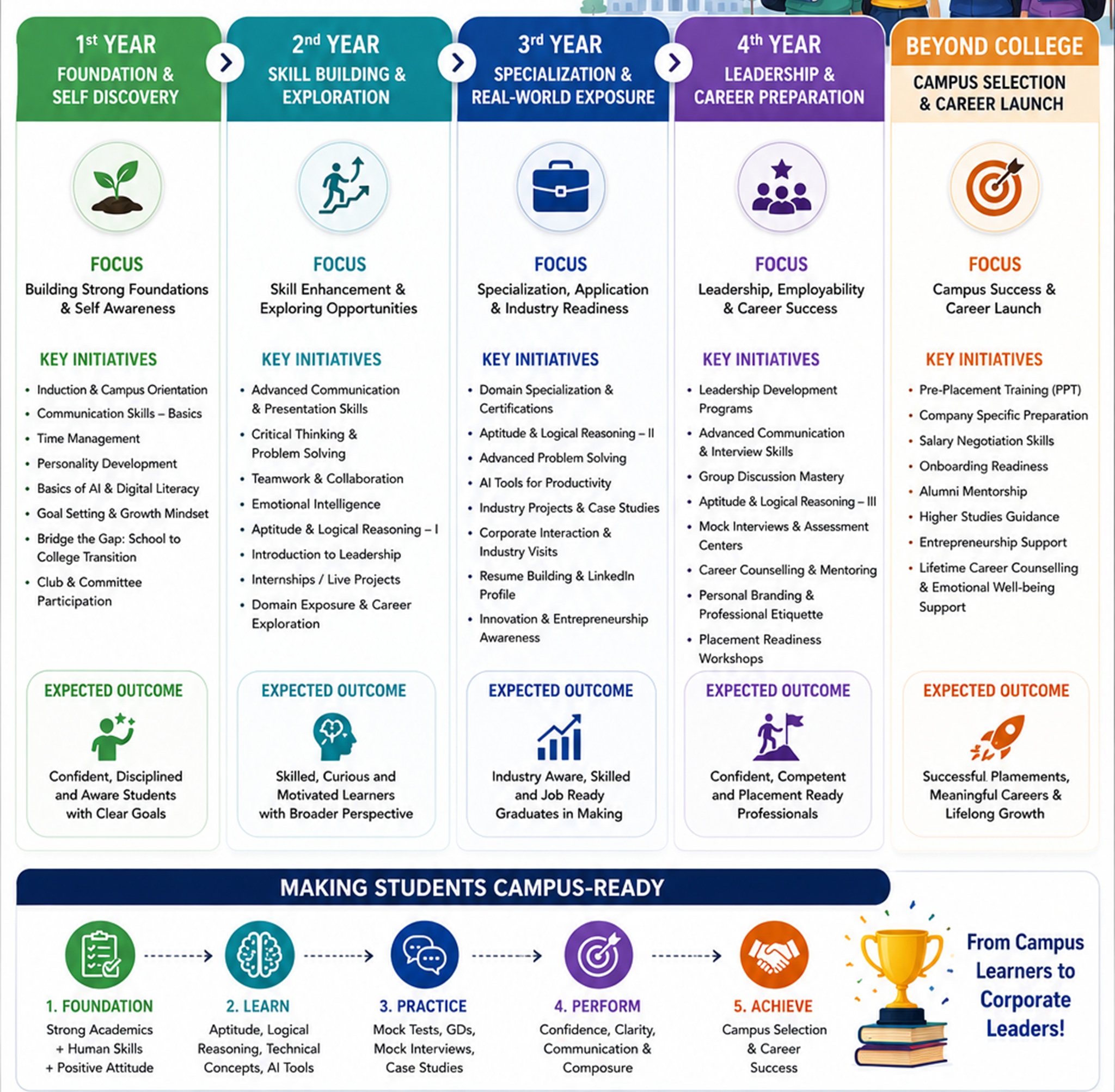
Year 1 – Foundation & Self-Discovery
Theme: Build the Student Before Building the Professional
The first year marks one of the most significant transitions in a student’s life—from school to higher education. During this period, students are adapting to greater independence, new social environments, and increased academic expectations.
Many students enter college without a clear understanding of their strengths, interests, or career aspirations. Therefore, the primary objective of the first year is not placement preparation but personal development.
Key Learning Areas
- College orientation and growth mindset
- Communication fundamentals
- Time management and productivity
- Personality development
- Emotional intelligence
- Goal setting
- Introduction to Artificial Intelligence
- Digital literacy
- Confidence building
- Team participation through clubs and activities
Suggested Activities
- Personality profiling
- Public speaking icebreakers
- Team-building challenges
- Self-reflection journals
- Vision board workshops
- AI awareness demonstrations
Expected Outcome
By the end of the first year, students become more confident, self-aware, disciplined, and motivated learners with a clear understanding of their personal and professional goals.
Year 2 – Skill Building & Career Exploration
Theme: Discover Strengths and Build Essential Human Skills
Once students have developed confidence, the focus shifts toward strengthening workplace competencies while encouraging exploration of various career paths.
This is the ideal stage to introduce advanced communication, leadership fundamentals, problem-solving techniques, and logical reasoning.
Key Learning Areas
- Professional communication
- Presentation skills
- Critical thinking
- Analytical reasoning
- Team collaboration
- Emotional intelligence
- Leadership fundamentals
- Aptitude preparation
- Career exploration
- Internship readiness
Suggested Activities
- Group presentations
- Business case discussions
- Design Thinking workshops
- Resume-building sessions
- Peer mentoring
- Industry expert interactions
- Innovation competitions
Expected Outcome
Students become curious learners who can collaborate effectively, solve problems creatively, and confidently explore career opportunities aligned with their strengths.
Year 3 – Industry Readiness & Professional Development
Theme: Bridge the Gap Between Classroom Learning and Industry Expectations
The third year is perhaps the most critical stage of professional preparation.
Students must begin understanding how organizations operate, how projects are executed, and what employers truly expect from graduates.
This is also the ideal stage for integrating AI into everyday learning and productivity.
Key Learning Areas
- Domain specialization
- AI productivity tools
- Industry case studies
- Advanced logical reasoning
- Project management
- Resume optimization
- LinkedIn branding
- Internship excellence
- Corporate etiquette
- Entrepreneurship awareness
Suggested Activities
- Live consulting projects
- Industry visits
- AI tool demonstrations
- Mock assessment centres
- LinkedIn profile clinics
- Case competitions
- Hackathons
- Innovation labs
Expected Outcome
Students graduate from being classroom learners to becoming industry-aware professionals capable of contributing meaningfully during internships and entry-level roles.
Year 4 – Leadership & Career Preparation
Theme: Transform Students into Confident Professionals
The final year is not merely about securing placements.
It is about helping students demonstrate confidence, professionalism, communication excellence, and leadership during the hiring process.
Key Learning Areas
- Interview mastery
- Advanced communication
- Group discussions
- Executive presence
- Leadership development
- Salary negotiation
- Corporate professionalism
- Personal branding
- Career counselling
- Workplace ethics
Suggested Activities
- Mock interviews
- HR simulations
- Leadership challenges
- Executive presentations
- Assessment centre simulations
- Networking workshops
- Employer interaction sessions
Expected Outcome
Students become placement-ready professionals equipped with both technical competence and the human skills required for long-term career success.
Beyond Graduation – Career Launch & Lifelong Development
Placement should never be viewed as the end of a student’s journey.
In reality, graduation marks the beginning of professional life.
As graduates progress through different stages—first job, promotions, leadership roles, entrepreneurship, or career transitions—they encounter new challenges that require continuous learning and guidance.
Forward-looking institutions can strengthen alumni engagement by encouraging lifelong learning opportunities, mentorship networks, leadership programs, and professional development resources that support graduates well beyond campus.
The Five-Step Campus Readiness Framework
A practical framework for every institution is:
1. Foundation
Develop discipline, confidence, communication, and a growth mindset.
2. Learn
Strengthen technical knowledge alongside AI literacy, reasoning, and human skills.
3. Practice
Apply learning through projects, internships, simulations, mock interviews, and industry engagement.
4. Perform
Build executive presence, communication, teamwork, and leadership through practical experiences.
5. Achieve
Support students as they transition into employment, higher education, entrepreneurship, and lifelong professional growth.
Why This Roadmap Matters
Institutions that adopt a structured, year-wise development model often observe benefits such as:
- Greater student confidence
- Improved communication and presentation skills
- Better internship performance
- Stronger placement readiness
- Higher employer engagement
- Increased alumni satisfaction
- Enhanced institutional reputation
Importantly, this roadmap complements—not replaces—the academic curriculum by integrating practical employability and leadership development throughout the student journey.
How Skills Ahead Consultancy Services Supports Colleges
Skills Ahead Consultancy Services Pvt. Ltd. partners with educational institutions to design and deliver structured student development initiatives that align with evolving industry expectations.
Programs may include:
- Human Skills Development
- Leadership Development
- Campus to Corporate Readiness
- AI Readiness Workshops
- Communication & Presentation Skills
- Critical Thinking & Problem Solving
- Design Thinking
- Employability Skills
- Career Counselling
- Faculty Development Programs
- Train-the-Trainer Initiatives
- Placement Readiness Bootcamps
- Executive Coaching & Mentoring
These offerings are designed to complement academic learning and help institutions prepare students for dynamic careers in an AI-enabled workplace.
Conclusion: Building Graduates Who Create Impact
The colleges that will lead in the coming decade are those that recognize education as more than the transfer of knowledge.
Their mission is to develop graduates who can think independently, communicate confidently, lead with integrity, adapt to technological change, and continue learning throughout their careers.
By adopting a structured, year-wise development roadmap that integrates human skills, AI readiness, leadership, and practical career preparation, institutions can significantly strengthen student outcomes and better align education with the future of work.
Because the future belongs not to colleges that simply produce graduates—but to colleges that develop capable professionals, responsible citizens, and future leaders.